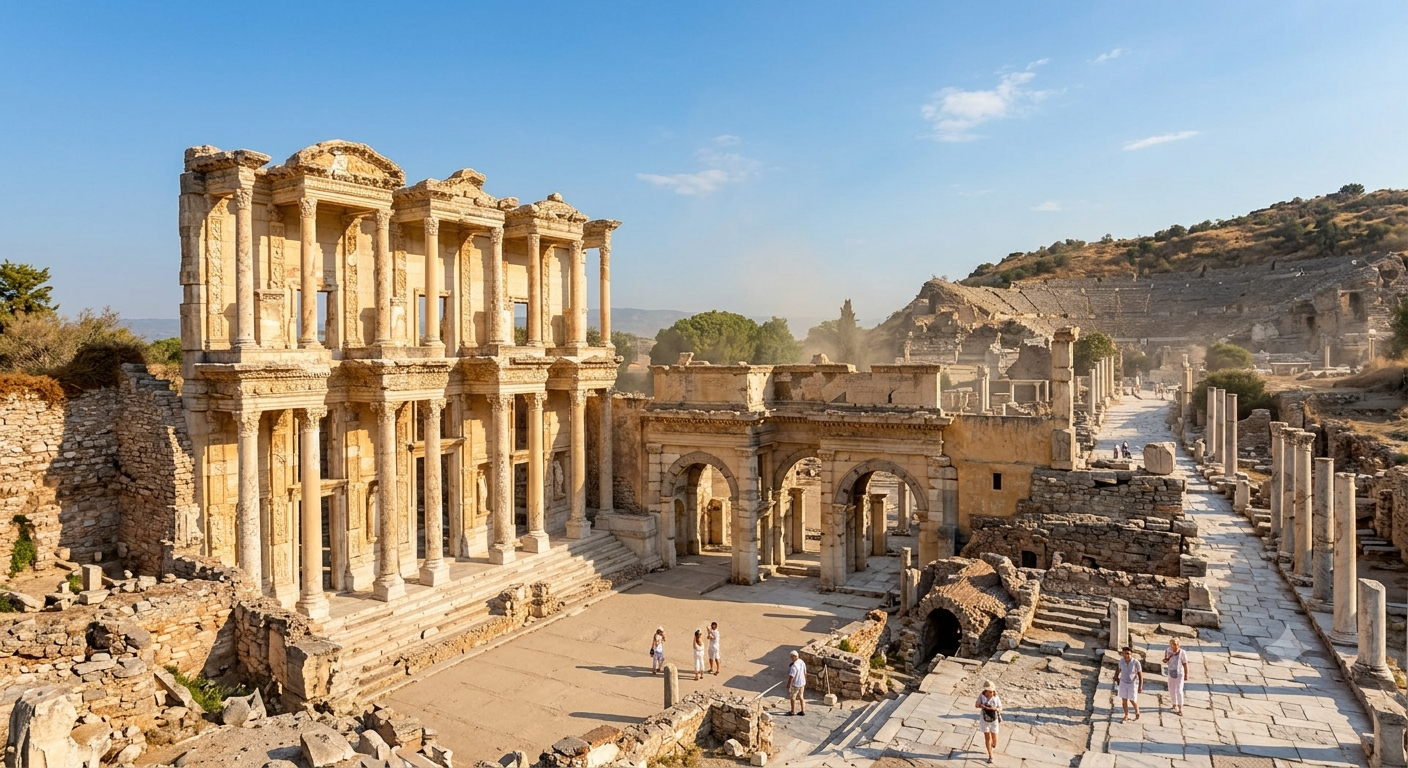
Ephesus stands as one of the best-preserved Classical cities in the Mediterranean. Located near the modern town of Selçuk on Turkey's western coast, this vast open-air museum lets visitors walk down authentic Roman marble streets, stand in massive ancient amphitheaters, and marvel at intricate stone carvings created over two thousand years ago.
Once a major Greek city, a bustling Roman port, and a vital center of early Christianity, Ephesus attracts millions of international travelers each year. Whether you are a history enthusiast, a photographer, or a first-time traveler to Turkey, planning a visit to the Ephesus ancient city requires practical knowledge on timing, logistics, and entry requirements.
Quick Facts for Visiting Ephesus
- Location: Izmir Province, Aegean Region, Turkey (near Selçuk)
- Recommended Time Needed: 3 to 5 hours
- Best Seasons: Spring (April–May) and Autumn (September–October)
- Entry Rule: International tourists must meet Turkey entry requirements, including a valid passport and an entry visa if applicable.
Why Visit Ephesus Ancient City?
Unlike many archaeological sites where only scattered foundations remain, Ephesus offers a remarkable look at daily Roman life. You can see public bath complexes, latrines, marketplace squares (Agoras), and grand temples standing in their original positions. During the Roman Empire, Ephesus served as the capital of the Asia Minor province, housing upwards of 200,000 residents.
It also holds deep significance for religious history. The Apostle Paul lived and preached in Ephesus for several years, writing letters to the early Christian community. St. John is also believed to have spent his final years in the area, contributing to the region's historical importance.
Famous Monuments and Top Ephesus Ruins
The main archaeological zone spans about two kilometers between two gates: the upper Magnesian Gate and the lower Harbour Gate. Walking down Curetes Street takes you past some of the most famous monuments in the ancient world.
1. Library of Celsus
The Library of Celsus is the undisputed icon of Ephesus. Built in the 2nd century AD to honor Roman Senator Tiberius Julius Celsus Polemaeanus, this two-story facade once stored over 12,000 parchment scrolls. The restored front structure features intricate relief carvings and statues representing wisdom, knowledge, virtue, and intelligence.
2. The Great Theatre of Ephesus
Carved into the slope of Mt. Panayir, the Great Theatre held an estimated 25,000 spectators. It was used for theatrical performances, political assemblies, and gladiator fights. Standing at the top row gives you a view down the ancient Arcadian Way toward where the harbor once lay.
3. The Terrace Houses
Located on a hillside opposite Curetes Street, the Terrace Houses offer a look into the lives of wealthy Ephesians. Protected under a modern climate-controlled shelter, these multi-story residential units feature remarkably preserved wall frescoes, mosaic floors, and early indoor plumbing systems. Note that visiting the Terrace Houses usually requires a separate entry ticket.
4. Temple of Hadrian and Curetes Street
Curetes Street connects the upper administrative area to the lower public monuments. Along this marble road stands the Temple of Hadrian, built in honor of the Roman Emperor Hadrian's visit. Its elegant arch, Corinthian columns, and relief panels depicting Medusa make it one of the most photographed spots in the park.
5. The Odeon
Near the upper entrance, the Odeon resembles a miniature theater. It served as a council hall (Bouleuterion) for city administrators and a venue for intimate music performances, seating around 1,500 people.
Hidden Gems and Nearby Attractions Around Ephesus
While most group tours stick strictly to the main ruins, spending extra time in the region allows you to explore surrounding historic sites.
- Temple of Artemis: Located just outside the main archaeological site, this was once one of the Seven Wonders of the Ancient World. Today, a single reconstructed column stands in a quiet field, serving as a reminder of the temple's former scale.
- House of the Virgin Mary: Situated on Mount Koressos, this stone chapel is believed by many to be the final home of Mary, mother of Jesus. It remains a tranquil shrine visited by pilgrims of various faiths.
- Basilica of St. John: Located in neighboring Selçuk beneath the Ayasuluk Fortress, this 6th-century Byzantine church built by Emperor Justinian marks the traditional burial site of Saint John the Apostle.
- Şirince Village: A short drive up into the hills from Selçuk, this historic Greek-influenced village is famous for narrow cobblestone streets, traditional Ottoman houses, and fruit wine production.
How to Visit Ephesus: Transportation and Logistics
Ephesus is situated near Selçuk in Izmir Province, making it easily accessible via multiple transport routes:
- From Izmir (Adnan Menderes Airport): Take the IZBAN commuter train directly from the airport to Selçuk station (approx. 1 hour), then board a local minibus (dolmuş) to the site entrance.
- From Kuşadası: Cruise ship passengers and beach resort travelers can catch frequent minibuses from Kuşadası central station direct to the lower gate of Ephesus (approx. 20–30 minutes).
- Ephesus Day Trip from Istanbul: Take an early morning domestic flight from Istanbul to Izmir Adnan Menderes Airport (ADB), hire a taxi or take a train to Selçuk, explore the ruins, and return via an evening flight.
Best Time to Visit Ephesus & Duration
The optimal months to visit are April through May and September through October. During these months, temperatures are comfortable for walking outdoors, and crowd levels are moderate compared to summer peak season.
July and August bring extreme heat, with temperatures often exceeding 35°C (95°F). Because there is very little shade among the marble streets, summer visitors should arrive early at opening time (around 8:00 AM) to beat both the heat and the cruise ship crowds.
Plan on spending at least 3 to 4 hours inside the main archaeological park. If you plan to visit the Terrace Houses, Basilica of St. John, and the Ephesus Archaeological Museum in Selçuk, set aside a full day.
Practical Travel Tips for Visitors
- Footwear: Wear sturdy, non-slip walking shoes. The ancient marble walkways are uneven and can be slick underfoot.
- Sun Protection: Carry a hat, sunglasses, high-SPF sunscreen, and plenty of water, especially between June and September.
- Audio Guides & Tours: Rent an official audio guide at the entrance or hire a licensed local guide to fully appreciate the historical context behind the structures.
- Start at the Upper Gate: Ask your taxi or driver to drop you at the upper (Magnesian) gate. This allows you to walk downhill toward the lower gate rather than hiking uphill.
Turkey Entry Requirements and Visa Information
Before traveling to Turkey to explore Ephesus, international tourists must verify their travel documentation. Entry rules depend entirely on your nationality and passport type.
Citizens of many countries can obtain a visa online prior to departure. Before finalizing your flight or tour bookings, check the official list of Turkey eVisa eligible countries to confirm whether your nationality permits online visa processing.
If eligible, you can complete the online form through our Turkey eVisa application portal. Having your documentation prepared in advance helps ensure smooth arrival procedures at Turkish airports and border checkpoints.
Standard processing usually takes 2–3 days. For travelers requiring quicker turnaround, our Super Rush processing option provides an expected processing time of up to 24 hours, subject to accurate information and government clearance. You can easily track your document progress via the Turkey eVisa status portal.
Please note: Our platform provides independent application assistance and review services. We are not a government agency, and actual entry permissions remain at the discretion of Turkish border authorities.
Leave a Comment
Share your questions, feedback, or experience regarding the news.
No Comments Yet
Be the first to share your experience or ask a question.